

The market for handheld, portable material-analysis instruments has grown steadily over the past several years, and Laser Induced Breakdown Spectroscopy (LIBS) is one of the techniques driving that growth. CEO’s high-power laser diode arrays are an enabling component inside these instruments, supplying the optical pump energy that makes fast, in-the-field elemental analysis possible.
How Handheld LIBS Identifies and Sorts Metals
LIBS determines elemental composition from the light emitted by a laser-generated plasma. A handheld analyzer focuses a short, high-peak-power laser pulse onto the sample surface. The pulse ablates a microgram-scale amount of material and heats it to tens of thousands of kelvin, forming a transient plasma. As the plasma cools, each element emits light at characteristic wavelengths. A spectrometer resolves that emission, and the relative line intensities are converted to a quantitative composition. No sample preparation is required, and a typical measurement completes in about one second per point.
Laser Diode Arrays as the LIBS Pump Source
Most handheld LIBS instruments use a Q-switched, diode-pumped solid-state (DPSS) laser based on Nd:YAG, emitting nanosecond pulses at 1064 nm with pulse energies on the order of 0.1 to 1.0 mJ. Reaching the irradiance needed to form a plasma in a tool an operator holds all day is fundamentally a pump-source problem. The pump diodes must couple high optical power into a small Nd:YAG volume, fit within a sealed, conduction-cooled handheld geometry, and hold performance across the temperature swings of field use. This is the function CEO’s laser diode arrays perform, and it is why the High Density Stack array lists LIBS among its popular applications.
Why LIBS Excels at Sorting Metal Alloys and Powders
A single trigger pull tells an operator the grade of the material in front of them, for example whether a piece of scrap is a 300-series stainless, a specific aluminum alloy, or a titanium grade. LIBS is particularly effective on light elements such as lithium, beryllium, magnesium, aluminum, and silicon, which are difficult to quantify with X-ray fluorescence, the competing portable method. Because the measurement reads bulk composition directly, LIBS also applies to metal powders, including feedstock verification for additive manufacturing and incoming-material checks. For scrap recyclers, foundries, and powder suppliers, this supports faster throughput, cleaner grade separation, and material verification without sending samples to a laboratory.
CEO Laser Diode Packages for Handheld LIBS Analyzers
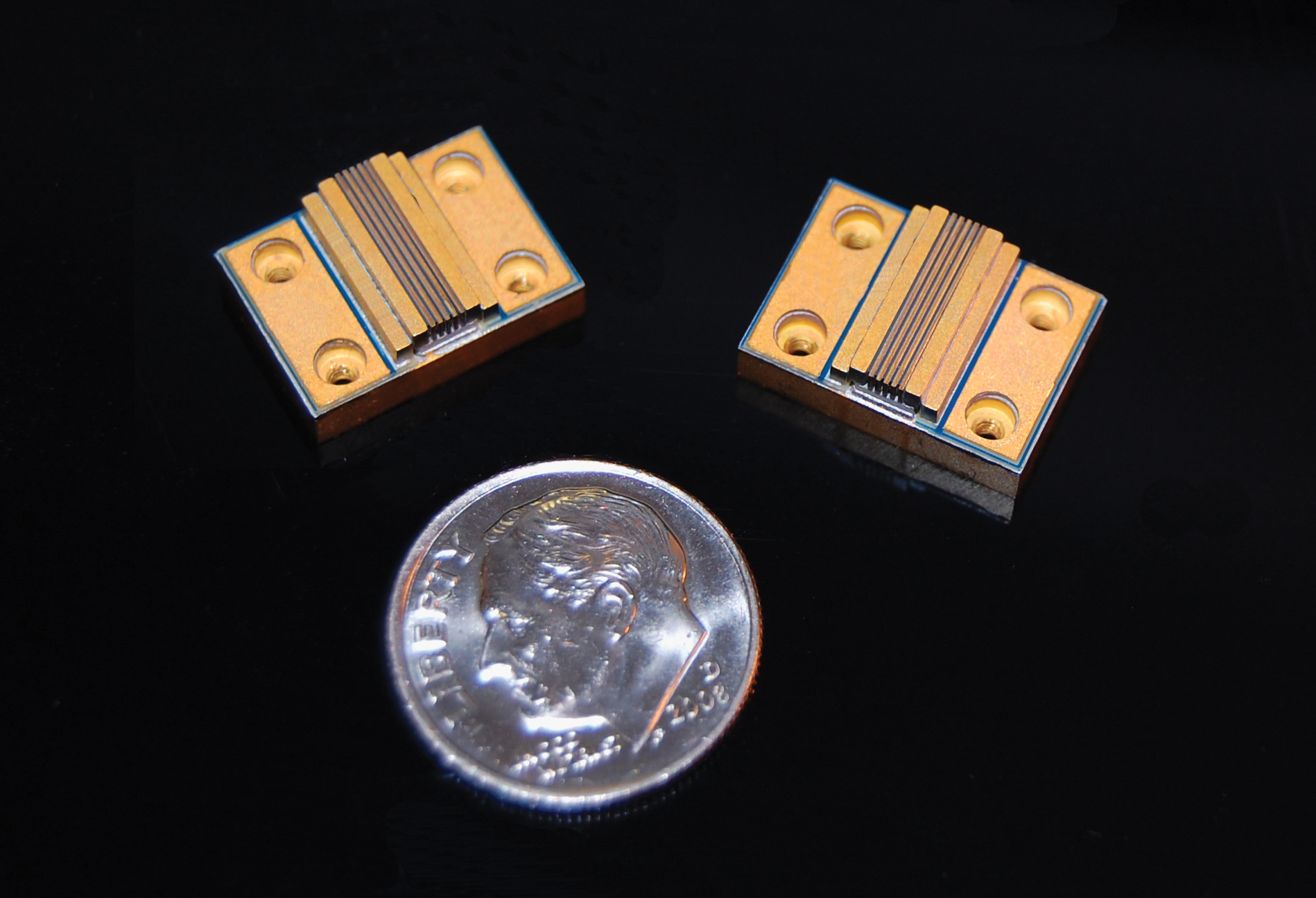
Fitting a capable pump source into a handheld analyzer is a size, weight, and power (SWaP) problem. CEO produces sub-compact, conductively-cooled laser diode packages that are substantially smaller and lighter than its standard A, G, and CS style packages. They are built around high-performance 5 mm and 10 mm laser diode bars spanning 790 nm to 980 nm, with hard-soldered, expansion-matched construction, and are rated for operation from -40oC to +80oC. The same wavelength range covers the 808 nm and similar pump bands used by Nd:YAG. For OEMs developing the next generation of analyzers, CEO also designs fully customized diode packages to meet specific geometry and SWaP targets, using the vertically integrated engineering process it applies to LIDAR, medical, and defense laser programs.
Specifying a Diode Source for Handheld LIBS
Handheld LIBS turns a complex laboratory measurement into a one-second field test. The performance of that test depends on a pump source that is compact, rugged, and thermally stable, which is precisely the class of laser diode array CEO manufactures. OEMs developing handheld LIBS or other portable material-analysis instruments can contact CEO’s sales engineering team to discuss a standard or custom diode solution.
Approved for Public Release: NG26-1434 Northrop Grumman © 2026 Cutting Edge Optronics, Inc