

Cutting Edge Optronics (CEO) has further advanced its high-performance diode-pumped solid-state (DPSS) laser product offerings with the development and testing of two Er:YAG laser modules. Each system incorporates an erbium-doped yttrium aluminum garnet (Er:YAG) crystal as the gain medium, optically pumped by CEO’s in-house-manufactured 97X nm laser diodes. This effort continues CEO’s long heritage of precision-engineered DPSS solutions for industrial, medical, and scientific markets, showcasing optimized efficiency, stability, and scalability in mid-infrared laser systems.
Why the 2.94 μm Er:YAG Wavelength Matters
The 2.94 μm emission wavelength is one of the most significant characteristics of Er:YAG lasers. This wavelength corresponds precisely with a strong absorption peak of water — the dominant component in soft biological tissue — giving it a unique advantage in medical and dental applications. When operating at 2.94 μm, tissue ablation occurs with exceptional precision and minimal thermal damage, as the laser energy is rapidly absorbed and dissipated without significant penetration beyond the target region.
The Er:YAG’s energy absorption profile also aligns well with the optical properties of hard tissues like bone, dentin, and enamel. For this reason, the laser has become a preferred tool for procedures such as dental drilling, cavity preparation, dermatological resurfacing, and orthopedic microsurgery. Beyond medicine, this wavelength is also valuable in scientific instrumentation and mid-infrared laser pumping, where efficient wavelength conversion and high beam quality are essential.
Er:YAG Laser Module Designs and Specifications
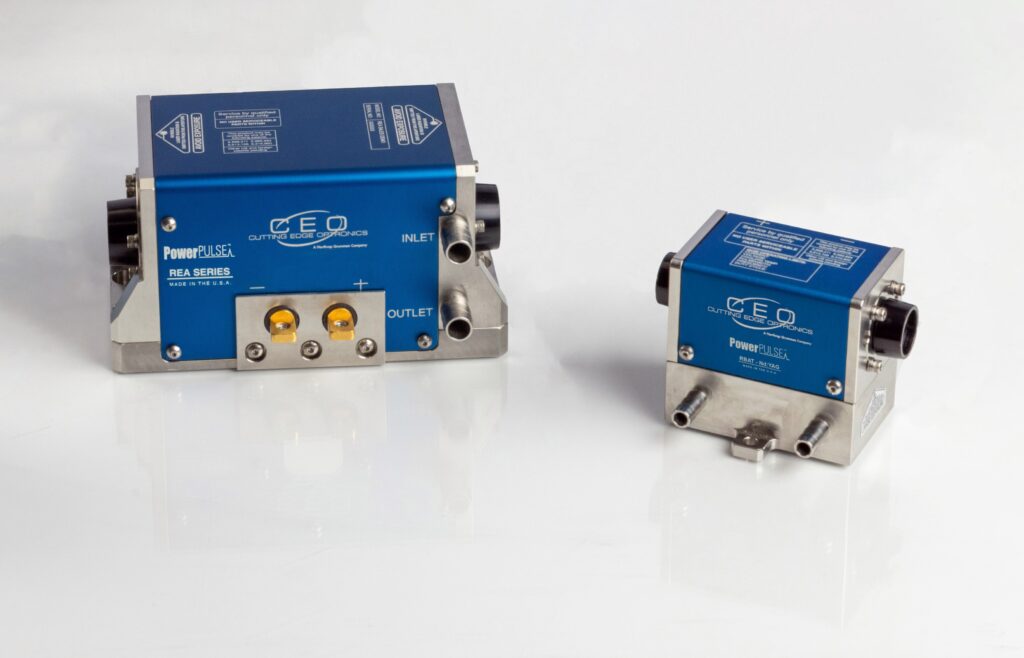
CEO evaluated two Er:YAG DPSS laser configurations designed to cover a wide performance range. The first, designated the RBAT model, employs a compact 2 mm diameter rod pumped by 45 diode bars, optimized for low-energy but high-repetition-rate operation. This configuration targets applications requiring less than 1 J per pulse, such as dermatological treatments or soft-tissue medical systems where precision and speed are critical.
The second, larger configuration, the REA model, uses a 5 mm diameter Er:YAG rod pumped by 160 diode bars. This design is intended for high-energy output exceeding 1 J per pulse, suitable for materials research, bone ablation, or as a pump source in multi-stage laser systems. These two experimental setups were selected to span a representative range of medical and industrial needs, demonstrating the scalability of the Er:YAG platform. Future configurations can be readily customized by adjusting diode array power, rod length, and cooling geometry to meet specific energy and repetition-rate requirements.
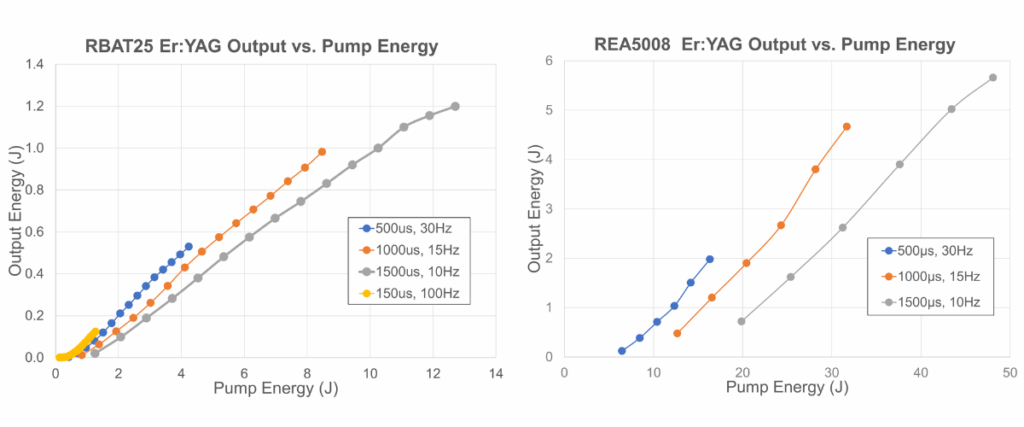
Output performance across both module types is presented in the accompanying graphs, showing the relationship between output energy and pump energy at multiple pulse durations (150-1500 μs) and repetition rates (10–100 Hz). These test results confirm near-linear energy scaling in both designs up to saturation limits, validating the efficiency of CEO’s diode-pumped architecture.
Performance Testing and Energy Output Results
During performance testing, the 2 mm RBAT module demonstrated particularly promising results. Operating at a 100 Hz repetition rate, it achieved pulse energies exceeding 100 mJ, establishing it as an effective platform for applications that demand both high pulse repetition and accurate energy delivery — a crucial requirement in photocoagulation, skin resurfacing, and minimally invasive surgical systems.
Conversely, the 5 mm REA system produced multi-Joule output levels at lower repetition rates, confirming its potential for laser sources where peak power is prioritized over speed. These findings highlight the adaptability of CEO’s DPSS module design: from compact, fast-pulsing Er:YAG systems to robust, high-energy configurations, the architecture remains consistent, modular, and thermally efficient.
An important observation is the consistent slope efficiency across configurations, a direct result of CEO’s optimized diode coupling and gain medium design. The company’s proprietary mounting techniques ensure precise thermal management and optical alignment, allowing stable performance across multiple operating regimes. The results affirm that CEO’s DPSS integration methodology yields reliable energy scaling, high optical-to-optical efficiency, and consistent beam output under varying operational conditions.
Long-Term Reliability and Proven DPSS Design
Reliability remains a cornerstone of any DPSS technology intended for clinical and research environments. Both the RBAT and REA Er:YAG modules are based on CEO’s long-standing, field-proven module designs used worldwide for oscillator and amplifier systems. These modules routinely achieve operational lifetimes exceeding 10 billion pulses, a metric that surpasses the expected service life of most medical laser systems.
The robust mechanical and thermal design minimizes degradation of optical components, while the diode arrays — built in-house — undergo extensive qualification to ensure consistency across production batches. This vertically integrated approach allows for strict quality control at every stage, from diode fabrication to final system assembly. In turn, customers benefit from predictable performance, simplified maintenance, and long-term cost efficiency.
Conclusion
CEO’s new Er:YAG modules offer a ready-made pump source for medical laser applications. Combining efficient diode pumping, precision-engineered rods, and rigorous lifetime testing, these modules provide a foundation for future medical and industrial technologies that rely on precise energy delivery at the 2.94 μm wavelength.